
Tortion Testis Treatment
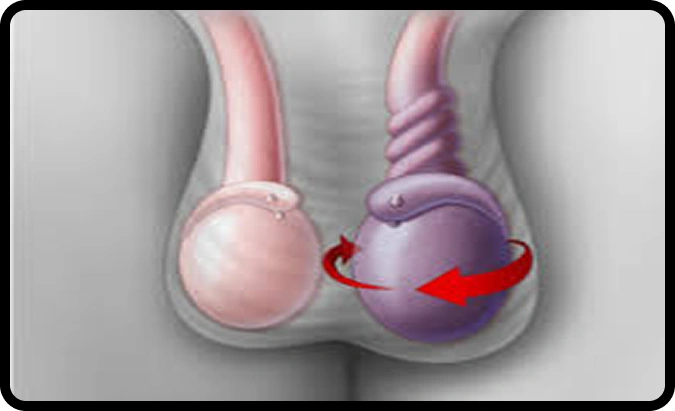
What is Testicular Torsion?
Testicular torsion is a medical emergency in which the testicle twists around the spermatic cord, cutting off its blood supply. This leads to sudden, severe pain and swelling in the scrotum.
If not treated immediately, testicular torsion can result in permanent damage or loss of the testicle.
Prompt diagnosis and emergency surgical intervention are crucial to save the testis and preserve fertility.
Why Does Testicular Torsion Occur?
Testicular torsion usually occurs due to a structural abnormality called the “bell clapper deformity”, where the testicle is not properly fixed inside the scrotum.
Common Causes & Risk Factors
- Congenital abnormal attachment of testis
- Sudden testicular movement
- Trauma or injury to the scrotum
- Physical activity or exercise
- Occurrence during sleep (common in adolescents)
- Cold weather causing cremasteric muscle contraction
Symptoms of Testicular Torsion
Testicular torsion typically presents suddenly and severely.
Common Symptoms Include:
- Sudden, intense pain in one testicle
- Rapid scrotal swelling
- Redness or firmness of the scrotum
- Nausea and vomiting
- Abdominal pain
- Testicle positioned higher than normal
- Pain not relieved by rest or medication
How is Testicular Torsion Diagnosed?
Diagnosis is made urgently to avoid delay in treatment.
Diagnostic Methods:
- Clinical examination by a urologist
- Doppler Ultrasound of the scrotum to assess blood flow
- Blood and urine tests (to rule out infection)
👉 If torsion is strongly suspected, surgery is performed immediately, sometimes even without waiting for imaging.
Treatment of Testicular Torsion
Emergency Surgical Treatment is the Only Definitive Solution
Testicular torsion cannot be treated with medicines alone. Surgery is required to untwist the testicle and restore blood supply.
Surgical Procedure for Testicular Torsion (Detorsion & Orchidopexy)
Step-by-Step Treatment Process:Tortion Testis
1. Emergency Admission
The patient is admitted immediately after diagnosis, usually within the golden window of 4–6 hours for best outcomes.
2. Anesthesia
The procedure is performed under general anesthesia.
3. Surgical Exploration
- A small incision is made in the scrotum.
- The twisted spermatic cord is identified.
- The testicle is carefully untwisted (detorsion).
4. Assessment of Testicular Viability
- The surgeon evaluates blood flow and color of the testis.
- If blood flow returns and the testis appears healthy, it is preserved.
- If the testis is non-viable (black or necrotic), removal may be necessary (orchiectomy).
5. Orchidopexy (Fixation of Testes)
- The affected testis is fixed to the scrotal wall to prevent future torsion.
- The opposite (normal) testis is also fixed prophylactically, as torsion risk is often bilateral.
6. Closure
- The incision is closed with absorbable sutures.
What if the Testis Cannot Be Saved?
If treatment is delayed beyond 12–24 hours, the testicle may become permanently damaged.
In such cases:
- The dead testis is surgically removed
- The remaining testis usually maintains normal hormone production and fertility
- Testicular prosthesis can be placed later for cosmetic purposes (optional)
Recovery After Testicular Torsion Surgery
Hospital Stay
- Usually 1–2 days
Post-Surgery Care
- Scrotal support and ice packs
- Pain relief medications
- Antibiotics (if required)
- Avoid strenuous activity for 3–4 weeks
Return to Normal Activities
- Light activities: 5–7 days
- Exercise & sports: After 4–6 weeks (as advised)
Book a Consultation
If you or a loved one needs a kidney transplant, consult Dr. Amit Goel, a trusted Urologist & Kidney Transplant Specialist, to discuss robotic or open transplant options and donor procedures.
📍 C2/902, Parsvnath Exotica, DLF Phase 5, Sector 53, Gurugram, Haryana 122003
📞 +91 84470 18167