Robotic Partial Nephrectomy / Nephron Sparing Surgery / Radical Nephrectomy with IVC Thrombus for Kidney Tumors
Overview
Kidney (renal) tumors can be benign (non-cancerous) or malignant (cancerous).
When a tumor is detected, the goal of treatment is to remove the cancer while preserving as much healthy kidney tissue as possible.
Depending on the size, location, and spread of the tumor, the treatment may involve:
- Robotic Partial Nephrectomy / Nephron-Sparing Surgery (NSS) – preserving the kidney
- Radical Nephrectomy – removing the entire kidney if required
Radical Nephrectomy with IVC Thrombus Removal – advanced surgery for tumors extending into the major vein (Inferior Vena Cava)
1. Robotic Partial Nephrectomy (Nephron-Sparing Surgery)
What It Is:
A minimally invasive robotic-assisted surgery where only the tumor portion of the kidney is removed while preserving the remaining healthy part.
This approach is ideal for small or localized kidney tumors.
How It’s Done:
- The patient is given general anesthesia.
- Through small incisions, a robotic system is used to precisely remove the tumor.
- The surgeon operates robotic arms via a console, ensuring 3D magnified vision and exact control.
- The cut portion of the kidney is reconstructed and sealed to maintain normal kidney function.
Benefits:
- Kidney preservation (important for long-term health)
- Less pain and blood loss
- Faster recovery and shorter hospital stay
- Minimal scarring
- Equal cancer control compared to open surgery
2. Radical Nephrectomy
What It Is:
- A radical nephrectomy involves removal of the entire kidney, surrounding fatty tissue, and sometimes nearby lymph nodes.
It’s recommended for large or aggressive kidney tumors that cannot be safely removed by partial nephrectomy.
How It’s Done:
- Can be performed robotically or via open approach, depending on the case.
- The affected kidney is detached from its blood vessels and ureter.
- Nearby tissues are inspected for any spread.
- The kidney is removed through a small incision or port.
Benefits:
- Complete removal of cancerous tissue
- Lower recurrence risk in advanced cases
- Robotic approach ensures faster recovery and minimal discomfort
3. Radical Nephrectomy with IVC Thrombus
What It Is:
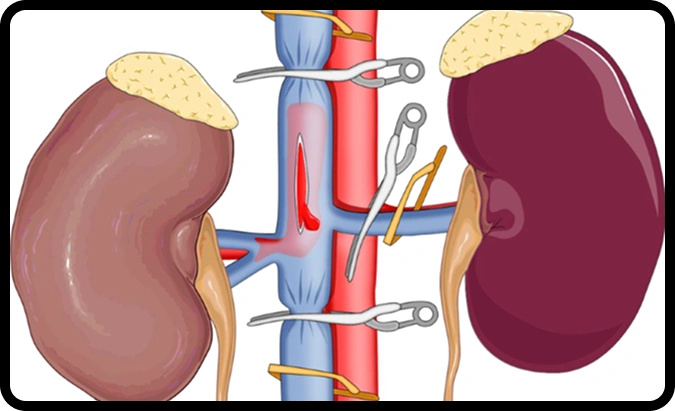
In some advanced kidney cancers, the tumor extends into the renal vein or even the Inferior Vena Cava (IVC) — the main vein carrying blood from the lower body to the heart.
This condition requires highly specialized surgery to remove both the tumor and the thrombus (tumor clot) safely.
How It’s Done:
- A multidisciplinary surgical team (urologist, vascular, and cardiac specialists) plans the procedure.
- The IVC is carefully opened, and the tumor thrombus is removed under controlled conditions.
- The vein is then reconstructed and blood flow is restored.
- The kidney containing the tumor is removed completely.
Benefits:
- Complete cancer clearance even in complex cases
- Improved survival and quality of life
- Safe, precise results with experienced robotic/urologic surgeons
4. Postoperative Recovery
- Hospital stay: usually 3–5 days for robotic procedures, longer for open or IVC cases.
- Most patients can resume light activities within 1–2 weeks.
- Follow-up includes imaging and blood tests to monitor kidney function and ensure no recurrence.
- Regular long-term surveillance is essential for early detection of any future changes.
5. Why Choose Robotic Surgery?
- High-definition 3D visualization
- Tremor-free precision during tumor removal
- Kidney preservation wherever possible
- Reduced postoperative complications
- Excellent cosmetic and functional outcomes
Book a Consultation
If you or a loved one needs a kidney transplant, consult Dr. Amit Goel, a trusted Urologist & Kidney Transplant Specialist, to discuss robotic or open transplant options and donor procedures.
📍 C2/902, Parsvnath Exotica, DLF Phase 5, Sector 53, Gurugram, Haryana 122003
📞 +91 84470 18167