
Robotic / Open Kidney Transplants with Lap Donor
Overview
A kidney transplant is a surgical procedure in which a healthy kidney from a donor is transplanted into a patient whose kidneys are no longer functioning effectively.
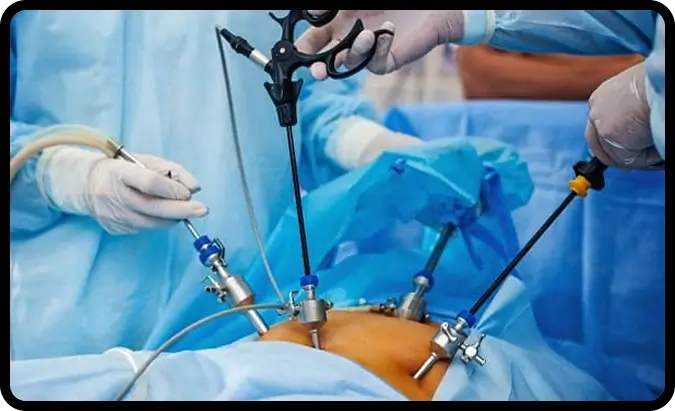
At our center, we specialize in both Robotic and Open Kidney Transplant surgeries, supported by advanced Laparoscopic Donor Nephrectomy techniques to ensure safety for both the donor and recipient.
This approach combines modern precision technology with experienced surgical expertise, offering optimal outcomes and faster recovery.
1. Donor Surgery – Laparoscopic Donor Nephrectomy
The donor kidney is retrieved using a minimally invasive laparoscopic procedure, ensuring comfort and safety for the donor.
Procedure Steps:
- Anesthesia: The donor is given general anesthesia.
- Small Keyhole Incisions: 3–4 small cuts (1–2 cm each) are made in the abdomen.
- Insertion of Camera and Instruments: A laparoscope (tiny camera) and fine surgical tools are inserted to access the kidney.
- Dissection and Removal: The kidney is gently freed from surrounding tissues, preserving blood vessels and the ureter.
- Extraction: The kidney is removed through a small incision (5–6 cm).
Closure: The incisions are closed with absorbable sutures.
1.1 What are the benefits for the Donor?
Benefits for the Donor:
- Minimal pain and scarring
- Less blood loss
- Shorter hospital stay
- Quicker recovery (return to normal life within 2–3 weeks)
Cosmetic advantage compared to open donor surgery
2. Recipient Surgery – Robotic or Open Kidney Transplant
Once the donor kidney is prepared, it is transplanted into the recipient (patient) using either a robot-assisted or open surgical approach depending on suitability.
Robotic Kidney Transplant
This is a minimally invasive, precision-driven surgery using robotic arms controlled by the surgeon. It offers exceptional accuracy and smoother recovery.
Procedure Steps:
- Small Incisions: 3–4 keyhole incisions are made for robotic instruments.
- 3D Vision & Control: The surgeon controls the robotic system, getting a magnified 3D view of the surgical field.
- Vascular Connection: The donor kidney’s blood vessels are connected to the recipient’s iliac vessels (artery and vein).
- Ureter Connection: The ureter (urine tube) is attached to the recipient’s bladder.
- Testing Function: The kidney starts functioning once blood flow is restored.
2.1 What are the Advantages of Robotic Surgery?
Advantages of Robotic Surgery:
- Smaller incisions and minimal blood loss
- Reduced pain and hospital stay
- Highly precise and controlled suturing
- Lower risk of wound infection (especially in obese or diabetic patients)
Early recovery and improved cosmetic results
2.2 Open Kidney Transplant-An Overview
This is the traditional approach used in complex or high-risk cases where robotic surgery may not be feasible.
Procedure Steps:
- Incision: A 10–12 cm incision is made in the lower abdomen.
- Placement of Kidney: The donor kidney is positioned in the lower abdominal cavity (right or left iliac fossa).
- Vascular and Ureteric Connection: The donor kidney’s artery, vein, and ureter are connected to the recipient’s vessels and bladder.
Closure: The incision is closed after confirming good kidney function and blood flow.
2.3 Advantages of Open Surgery
- Ideal for complex anatomical cases
- Trusted and time-tested technique
- Effective when robotic setup is unavailable or unsuitable
3. Post-Operative Care
For the Recipient:
- Close monitoring in the ICU for 24–48 hours
- Immunosuppressive medication to prevent organ rejection
- Regular blood tests and ultrasound to assess kidney function
- Gradual increase in mobility and diet
For the Donor:
- Mobilization within 24 hours
- Minimal postoperative discomfort
- Discharge usually within 2–3 days
- Follow-up to ensure full recovery of remaining kidney function
4. Outcomes & Success Rates
- Robotic and laparoscopic-assisted kidney transplants show excellent long-term graft survival.
- Patient recovery is faster and more comfortable than traditional open-only techniques.
- With experienced surgeons, both donor safety and recipient outcomes are highly successful.
📞 Consult Now
If you or a loved one needs a kidney transplant, consult Dr. Amit Goel, a trusted Urologist & Kidney Transplant Specialist, to discuss robotic or open transplant options and donor procedures.
📍 C2/902, Parsvnath Exotica, DLF Phase 5, Sector 53, Gurugram, Haryana 122003
📞 +91 84470 18167